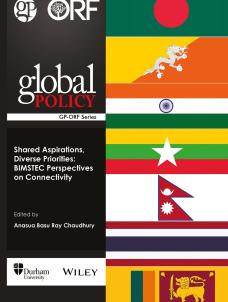
As an emerging zone of convergence between South and Southeast Asia, the Bay of Bengal has gained strategic and economic prominence within the broader Indo-Pacific framework. At the heart of this regional cooperative architecture lies the Bay of Bengal Initiative for Multi-Sectoral Technical and Economic Cooperation (BIMSTEC), which emphasises connectivity as a cardinal pillar to regional growth and development. Since its inception in 1997, BIMSTEC has identified ‘transport and communication’ as a key area of cooperation. At the 5th BIMSTEC Summit in March 2022, this sector was reorganised and renamed ‘connectivity’(1). Anchored in principles of equality, non-interference, and mutual benefit, the BIMSTEC Charter (adopted in March 2022) entrusts Thailand with leadership in advancing this sector.
Edited by Anasua Basu Ray Chaudhury, this volume examines how BIMSTEC’s connectivity agenda reflects the collective aspirations of its member states—Bangladesh, Bhutan, India, Myanmar, Nepal, Sri Lanka, and Thailand—for shared prosperity, regional resilience, and openness in a multipolar Indo-Pacific. Despite differences, these countries share a broad consensus that greater connectivity is key to unlocking the region's economic potential and advancing its development. BIMSTEC encourages cooperative integration and open regionalism through port development and cross-border electricity trade. Simultaneously, efforts to enhance resilient infrastructure, coupled with diversification of supply networks, address the region's growing vulnerability to economic disruptions, environmental challenges, and geopolitical changes.
To download for popular e-readers please see below or for a PDF version click here.
CONTENTS
Introduction: Unlocking BIMSTEC’s Potential - Anasua Basu Ray Chaudhury
Common Goals, Open Futures: Strengthening Regionalism through Collaboration in the Bay of Bengal
1. Reenergising the BIMSTEC Through an Internal Refocus - Sreeradha Datta
2. Bridging the Gap Between Rhetoric and Reality: Institutionalising BIMSTEC - Pratnashree Basu
3. Towards Stronger Regionalism through BIMSTEC: A Nepali Perspective - Nishchal N. Pandey
Connectivity for Prosperity: Member States’ Priorities to Achieve Common Goals
4. Connectivity as the Driver of Prosperity: The Myanmar, ASEAN, and BIMSTEC Perspective - U Kyaw Nyunt Lwin
5. Thailand’s Connectivity Priorities to Achieve Common BIMSTEC Goals - Surat Horachaikul
6. Building Energy Partnerships in BIMSTEC: From Bilateral Relations to Regional Networks - Roshan Saha and Anasua Basu Ray Chaudhury
7. The BIMSTEC Promise, From Sri Lanka’s Perspective - Aditya Gowdara Shivamurthy
8. The Prospects of Ports: India’s Sagarmala and BIMSTEC’s Maritime Future - Sohini Bose
Sustainable Growth and Economic Diversification: Responses from Regional Stakeholder
9. BIMSTEC and Bhutan’s Path to Sustainable Growth and Economic Diversification - Karma Dorji
10. Bay of Possibilities: Assessing BIMSTEC’s Geoeconomic Awakening - Soumya Bhowmik
11. India’s Wish List from BIMSTEC: Strategic Priorities, Trade–Economy–SDG Linkages, and Risk Management - Nilanjan Ghosh
12.Driving Regional Prosperity: Bangladesh’s Approach to Sustainable Growth and Economic Diversification in BIMSTEC - Khondaker Golam Moazzem and Sabiha Sharmin
Building Resilience: Considering Non-Traditional Security Among Member States
13. From Commitments to Action: BIMSTEC’s Challenge in Combating Trafficking - Sreeparna Banerjee
14. Nature, Nations, and Nourishment: Reframing Food Security in BIMSTEC - Shoba Suri
15. Enhancing Resilience Against Non-Traditional Security and Boosting Connectivity in BIMSTEC Through Education - Arpan Tulsyan
16. Bangladeshi Views on the Environment and Human Security in the BIMSTEC Region - Sufia Khanom
17. Bridging the Bay: Toward a Connected Health Architecture in BIMSTEC - Oommen C. Kurian and K.S. Uplabdh Gopal