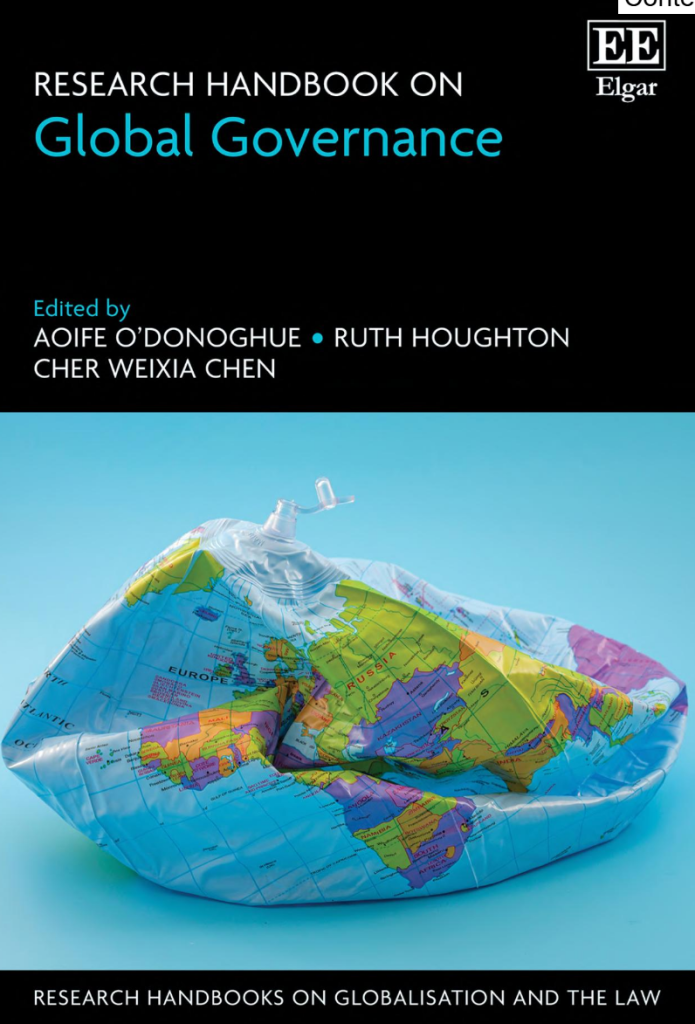
Research Handbook on Global Governance


Aoife O’Donoghue, Ruth Houghton and Cher Weixia Chen introduce a new handbook: Research Handbook on Global Governance (Edward Elgar 2025) ISBN: 978 1 78990 632 5. Extent: 632 pp
Our Research Handbook on Global Governance was published in November 2025. At the time of publication, and indeed throughout our time of collective writing, war raged on in countries around the world, communities struggled to rebuild their homes and lives following devastating weather events caused by climate change, and the gap between the global poor and the rich continued to expand. A global pandemic deeply affected people across the world, often against a backdrop of varying abilities of governments to provide healthcare and vaccine access. Frequently, this capacity was set within a global governance frame which was wholly inadequate and punished those states and the peoples that they serve. Against that bleak context, global governance seems insufficient and ineffective, and in many instances, harmful.
Such a damning assessment of global governance is the starting point for the new edited collection that seeks to proffer a critical, interdisciplinary account of both the scholarship and practice of governance beyond the state. One that also examines the impact of global governance at the local and regional levels and how interactions of law and politics occur outside the traditional tiered model. Building on that analysis, it also offers radical, novel and innovative research agendas and trajectories, alongside providing new methods and approaches for the field.
 The Handbook is structured around six substantive sections: (ii) Theoretical Foundations, (iii) Governance and Accountability, (iv) Human Rights, (v) Environment and Economic Governance, (vi) Peace and Conflict, and (vii) History and Alternative Futures. Anxious to avoid a bifurcation of theory and practice, as often appears in the content’s pages of collections, the chapters in the handbook weave together theoretical and conceptual work with assessments of contemporary challenges and issues. This approach was inspired by feminist, queer and critical approaches and by the activism of some of the authors.
The Handbook also seeks to invigorate the more traditional conceptual frameworks in global governance of justice, legitimacy, and democracy, and includes feminist, Marxist, queer, postcolonial, and decolonial approaches, and critical race theory. For example, questions of race, racism and gender inequalities are explored through questions of care and welfare (see chapter 6), and questions of gender and intersectionality are interrogated in the context of multi-level governance (see chapter 8), while analysis of the international law on the use of force is taken out of some of its traditional frames (see chapters 21 and 22).
A key investigatory theme running across the chapters in the Handbook is the diversification of actors operating within global governance. Moving beyond the traditional participants of states and international organisations such as the United Nations, the chapters demonstrate the multiplicity of roles played by a myriad of different actors: some more familiar to the literature, such as non-governmental organisations and civil society groups, whilst others such as social movements, experts, Indigenous communities, multi-national corporations, as well as the role of national and regional financial bodies, courts and judges expose how ubiquitous global governance can be. In discussing the different actors, the Handbook centred the perspectives of the “governed” rather than focusing on the “governing”, and there are chapters that foreground the experiences of Indigenous communities (see chapters 15 and 19), women and feminist networks (see chapters 3 and 6), and persons with disabilities (see chapter 14). Those that are often on the margins of global governance are made central to the discussion. In a similar vein of uncovering the peripheries of global governance, some chapters revisit well-known actors to focus on underexplored aspects of their work. For example, chapter 23 investigates the UN’s work on peace mediation. The various ways in which these actors contribute to the development, interpretation, application and enforcement of global governance put into question the standard reading of state-centric ideas of governance.
The “Global” in Global Governance
As well as questioning the “governance” aspect of global governance, the handbook places particular emphasis on interrogating the meaning of “global”. For example, “global” can mean interactions across stateborders, it can encompass ideas of the world or the planet, or it can be a specific level of legal and political governance beyond the state that somehow surpasses international law and its institutions. It can also be supremely local. These multiple understandings of global are dissected across the handbook.
The idea that global moves beyond the state is interrogated through chapters that place the state back in the frame, whether that is through national examples or by looking “below the state” at local and contextual examples of where governance becomes operational. Chapters in the handbook look to Belgium, Northern Ireland, Colombia, South Africa, and Palestine, for example (see chapters 8, 19, 10, and 16). Some chapters take a more regional approach, with a focus on Sub-Saharan Africa (see chapter 13) or centre Indigenous experiences (see chapters 15 and 19), for instance, to show the ways in which mechanisms of governance transcend the traditional framework of the “state” and how particular approaches to “global” can obfuscate some areas of experience. Examples across technology and ecology further complicate what we understand as global in the contemporary era (see chapter 17), with debates on the emerging approach of ‘earth systems law’ highlighting the limits of modern scientific knowledge on the scope of what could be meant by “global” (see chapter 18). In drawing these different approaches together, the Handbook hopes to provide an important, critical reading of global governance.
Global Governance is Interdisciplinary
One of the novel features of the handbook is the plethora of methods and disciplinary perspectives that are discussed and utilised. Studying the role of law in global governance necessitates such an interdisciplinary approach for forging a new understanding. The handbook places law in conversation with research in international relations, political theory and political science, history, literature, media ecology, and more. The outcome of this interdisciplinary writing process is that across 27 chapters, the handbook brings together the research of 38 authors who work across a variety of different disciplines, with many of the chapters being written at the intersection of two or more disciplinary silos.
The handbook draws on historical methods to interrogate the colonial underpinnings of global mechanisms of governance, international institutions, and the role of international law in perpetuating violence (see chapters 24 and 25). Looking to history and the humanities helps us to uncover the continuities and ruptures across the linear disciplinary narratives of more traditional conversations. Within the handbook, literary methods are used to reimagine the study of global governance (see chapter 26). Activism and that form of experiential knowledge is also part of the discussion.
As a truly interdisciplinary endeavour, the Handbook promises to provide readers with a fuller account of the role of law in global governance. Drawing disciplines together forges new research questions and methods, which can inform future studies of global governance.
Global Governance needs Diversity
Driven by a commitment to inclusivity and diversity, and to avoid the reestablishment of a canon on what global governance means or what it includes, the book showcases the voices of scholars, researchers, activists and practitioners from around the world. Chapters across the book speak to the experiences of people from different countries and regions. Global Governance is failing, in many ways, it already has failed most of the people on the planet. To see the failures and to find ways forward in both the practice and scholarship of global governance we will need all the voices, experiences, and knowledges (including a variety of forms of knowledge) to be present. The Research Handbook on Global Governance goes a very small way in that direction.
Whether we focus on the failings, harms, and challenges of global governance, or whether we look to the increasing necessity for cross-border legal and political responses, cooperation and collaboration in response to the issues facing society, the study and practice of global governance is in need of a thorough critical analysis and an injection of rigorous alternative approaches. The Research Handbook on Global Governance seeks to provide such a necessary intervention into the scholarship.
Aoife O'Donoghue (Professor of Law, Queen's University Belfast, School of Law, UK), Ruth Houghton (Senior Lecturer, Newcastle Law School, Newcastle University, UK) and Cher Weixia Chen (Associate Professor, School of Integrative Studies, George Mason University, USA).