Book Review - Qatar and the United Arab Emirates: Diverging Paths to Regional and Global Power

Qatar and the United Arab Emirates: Diverging Paths to Regional and Global Power by Emma Soubrier. Boulder, C.O.: Lynne Rienner Publishers, 2025. 261 pp., $110 hardcover 978-1-962551-06-9, e-book 978-1-962551-94-6
Qatar and the United Arab Emirates (UAE) are two states with very different regional visions. But they share a commonality: both are increasingly visible on the regional and indeed the international stage.
The UAE and Qatar have emerged with larger-than-life roles in the emerging regional order. Qatar is a US Major Non-NATO Ally, whilst the UAE’s soft power is unparalleled throughout the region. Both states have accepted President Trump’s invitation to join the Board of Peace, which will not only seek to rebuild and rehabilitate the Gaza Strip but may even serve as a springboard to mitigate any other regional conflicts that emerge. This impressive level of power projection – combined with the less positive fact that both Abu Dhabi and Doha are currently prime targets for Iranian ordnance – makes Qatar and the UAE worthy of further analysis.
Both states are dwarfed in size and assets by much more powerful and often threatening neighbours, such as Saudi Arabia and Iran. Qatar and the UAE are often labelled small states and thus are particularly vulnerable to conquest. Both are also in the Middle East, a region which is exceptionally violent. This was just true before the current regional conflagration at the time of writing; it is sadly even more true today. This all begs the question: given the historic and contemporary challenges, how have Doha and Abu Dhabi not only survived, but also thrived?
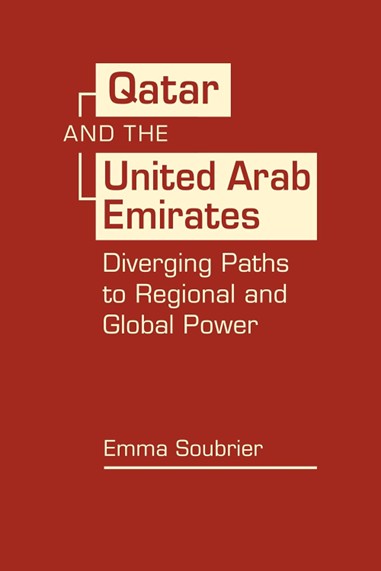 This is why Emma Soubrier’s book, Qatar and the United Arab Emirates: Diverging Paths to Regional and Global Power is a timely and important contribution to the growing but still very limited literature on either power. Soubrier seeks to answer not only the above question but also to chart the divergences between both these states in how they see the region, their role in it, and their chosen means to achieve security and prosperity.
In short, even though Soubrier does not employ the term herself, the book presents an excellent framework to comparatively assess the grand strategies of both states.
As Soubrier rightly notes in the book’s introduction, both Qatar and the UAE have transitioned from being relatively unknown actors into states that now punch far above their weight and play a significant role in shaping regional politics. Among the smaller Gulf monarchies, no others have been as headline-making, activist, or strategically self-confident.
The book adopts an historical-comparative structure, though not overly prescriptively so. Its analysis begins in the 1990s (Chapter III) through the late 2010s (Chapter VI). This periodisation is well chosen. It captures the transformation of both states from cautious actors into assertive players willing to shape regional outcomes rather than merely adapt to them. Throughout, Soubrier is attentive to how external shocks, notably the 2008–09 global financial crisis and the subsequent ‘Arab Spring’, altered the UAE and Qatar’s threat perceptions and expanded their opportunity structures, albeit in very different ways.
One of the book’s most original contributions lies in its conceptual framing. Rather than treating Qatar and the UAE as small states, which is how they are often categorized in the literature, Soubrier advances the concept of the ‘prince state’. This is a welcome innovation, given that ‘small states’ is such a broad term and umbrella concept that it is often poorly defined, which muddies comparative analysis and makes generalization less feasible.
Instead, Soubrier defines a ‘prince state’ as a political system in which the focus of security decisions shifts from regime survival, which is typical of dynastic monarchies, to a more concentrated emphasis on the power, vision, and personal networks of the ruling prince. In both cases, Soubrier argues, individual leaders articulated distinctive visions of national purpose and mobilised internal institutions and external statecraft to realise them.
This a useful framework for answering the most compelling research question that the book poses: why did two structurally similar states adopt such markedly different strategies? Soubrier locates the answer primarily in leadership. In Qatar, Sheikh Hamad bin Khalifa Al Thani – who reigned from 1996 to his abdication in 2013 – oversaw a strategy oriented toward external influence, through mediation and soft power projection. In the UAE, Mohammed bin Zayed Al Nahyan – who remains in power at the time of writing – pursued a more internally focused strategy aimed at autonomy, control, and accumulating hard power. Yet both have also sought to build and cultivate their own, distinct brand.
Soubrier further argues that, for both Qatar and the UAE, closer ties with the United States were not merely a defensive strategy to mitigate against external threats. Whilst this was an important aspect of the relationship, deeper engagement with Washington also signaled a Qatari and Emirati ambition to assert themselves regionally and globally. As the book demonstrates, both states became increasingly capable of influencing the behaviour of others, while simultaneously insulating their own policy choices from external pressure. This, in short, was the key to their successful rise in influence and power projection.
Another interesting takeaway that the book exposes is the contradictions in Qatari and Emirati policy planning: both want to shift to diversify their economies and boost their private sectors. But in both cases, many ‘private sector’ businesses are not private at all; instead, they operate according to the whims of government bureaucracy or even each country’s respective ruling ‘Prince’ (Chapter IV). Equally noteworthy is Soubrier’s focus on ‘globalized rentierism’, where the UAE and Qatar sought to expand their internal rentier state model outwards, for instance by buying up assets and adding to their payroll worldwide to project their influence.
Concurrently, there are several key areas that the book touches on which need further unpacking. The first is the need for greater conceptual clarity around what a ‘prince state’ is. This is not helped by the author attempting to coin a new conceptual framework for the UAE and Qatar, whilst also using the terms ‘middle power’ and ‘small state’ interchangeably. Curiously, the discussion on how personalities shape state policies (pages 124-125) almost entirely employs western leaders as case studies, rather than their Gulf counterparts.
Second, there is relatively little on the ‘Qatar Crisis’ that precipitated a UAE-led boycott of Qatar by most Gulf states from 2017 until 2021. This is a curious oversight since it is the obvious angle of pivotal interest for readers of this book, yet it comes very late (pages 164 – 166) and is covered in little detail. Similarly, just one paragraph on page 193 covers the ‘Abraham Accords’ where the UAE and later Bahrain broke with other Gulf countries to normalize relations with Israel. This omission feels more pertinent in a post-October 7 environment.
These critiques notwithstanding, Qatar and the United Arab Emirates: Diverging Paths to Regional and Global Power is a strong and substantive study. For scholars and students alike, it is best read alongside the small but growing literature that examines Gulf states’ foreign and security policies more broadly. It succeeds as a focused deep dive into two pivotal Gulf states and will be of interest to scholars and practitioners concerned with Gulf politics, small-state strategy, and the Middle East’s changing order.
Dr. Rob Geist Pinfold is Lecturer in Defence Studies (International Security) at King’s College London, Research Fellow at the Peace Research Centre Prague, and an Adjunct Professor at Johns Hopkins University’s School of Advanced International Studies (SAIS).