Book Review - The Law and Politics of International Legitimacy


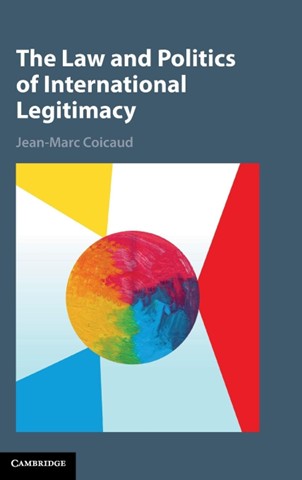
The Law and Politics of International Legitimacy by Jean-Marc Coicaud. Cambridge: Cambridge University Press 2025. 544 pp., £125 hardcover 9781107008274
Legitimacy has arguably become one of the most contested concepts in contemporary international law and global governance. Invoked by states, institutions, and social movements alike, it functions both as a normative benchmark and as a site of political struggle. Yet at the international level, legitimacy appears increasingly fragile. The prevailing instability and uncertainty surrounding the international legal system have cast doubt on whether international legitimacy can still be meaningfully sustained. And yet, despite this fragility, legitimacy continues to be claimed, contested, and sought after – much as it is at the domestic level. It is this paradox, and its implications for international law, that Jean-Marc Coicaud skilfully addresses in The Law and Politics of International Legitimacy.
In the Law and Politics of International Legitimacy, Coicaud addresses this challenge through a sustained and ambitious examination of legitimacy at the international level, with international law at its core. Drawing on political theory, legal scholarship, history, and his own professional experience, Jean-Marc Coicaud develops a framework for analysing how legitimacy is constructed, evaluated, and contested in international life. Rather than equating legitimacy with legality, or treating it as a purely sociological phenomenon, the book insists on their analytical distinction while exploring their mutual dependence. In doing so, Coicaud offers both a conceptual clarification of international legitimacy and a critical account of the role international law plays in sustaining, and at times undermining, it.
 Unsurprisingly then, one of the book’s major strengths lies in its conceptual foundations. Coicaud opens with his own intellectual and professional trajectory in Part I, situating the analysis within long-standing debates in political theory and international law, as well as lived experience in international institutions, most notably the United Nations (UN). This grounding lends authority to the book’s core conceptual move: the careful disentangling – without separation – of law and legitimacy. In Chapter 3, Coicaud insists that “legitimacy and law do not have a simple and straightforward relationship – far from it” (p. 40). Law cannot function without legitimacy, yet legitimacy cannot be reduced to legality. As he puts it, “law is essential to legitimacy, but legitimacy is equally central to law – and, arguably, even bigger than law” (p. 41). This framing avoids both legal formalism and sociological reductionism, allowing legitimacy to be treated as a normative, political, and institutional phenomenon.
The book then turns, in Parts III and IV, to legitimacy at the international level. Contrary to views that treat legitimacy as marginal in international affairs, Coicaud convincingly argues that “the issue of political legitimacy is far from being secondary, let alone, nonexistent, at the international level” (p. 99). Increased interdependence among states and societies has only intensified legitimacy concerns. At the same time, the international community remains ambiguous, fragmented, and marked by deep power asymmetries. Coicaud adopts a nuanced position, acknowledging that “some sense of international community exists today,” while emphasizing that relations of power, especially among states, remain deeply unbalanced and frequently favour the most powerful actors (p. 122).
International law, in this account, is the primary language through which international legitimacy is constructed and contested. Part IV identifies five building blocks of legitimacy embedded in international law: international membership, rights holding, the hierarchy of principles and rights, rightful conduct, and international authority. This systematic exposition is one of the book’s most impressive achievements. It demonstrates how international law simultaneously includes and excludes, granting rights and recognition while marginalizing certain communities and individuals. The analysis of international rights holding is particularly insightful, showing how the selective character of international membership imposes costs not only on societies that fall short of statehood requirements but also on their individual members.
Importantly, international law is not presented as a panacea. Coicaud is attentive to its historical and philosophical limitations, including colonial legacies that continue to undermine its legitimacy claims. This critical engagement strengthens the book’s overall argument: international law constructs a sense of international legitimacy, but it can also erode it. One area where the analysis might have gone further, however, concerns institutional practice. While international law is convincingly described as the language of legitimacy, the book engages only sparingly with sites where this language is actively articulated, and would have benefited from inclusion of, for example, decisions of the International Court of Justice (ICJ) or the work of the International Law Commission. Particularly at a time when the ICJ is increasingly requested by states to clarify and contest legitimacy claims through the language of international law.
Part V addresses change and international legitimacy, rejecting the tendency to equate legitimacy with stability. Coicaud shows that legitimacy is often most contested during periods of transformation, particularly when shifts in power are involved. As he observes, “finding the right equilibrium internationally between status quo and change can be relatively manageable when the call for change is minimal… [but] quite different when the challenge asks for a profound transformation… part of a massive international redistribution of power” (p. 155). This insight speaks directly to contemporary debates about the erosion of Western dominance and the reconfiguration of global order.
A key contribution of this section is the argument that legitimacy crises are largely endogenous. As Coicaud writes, “the present international system has a global dimension more than ever before,” and while its reach is uneven, “in one way or another, all regions are affected by this global dimension” (p. 357). Consequently, “most of what happens in and to this international order and its legitimacy is endogenous to them and their dynamic” (p. 357). This framing avoids simplistic narratives of external disruption and instead highlights how existing hierarchies and practices generate legitimacy deficits from within.
These reflections lead to a central normative concern of the book’s final part: how to distinguish genuine from spurious claims of legitimacy? “This issue is important,” Coicaud argues, “because it concerns how true international legitimacy can be distinguished from false international legitimacy, especially in the midst of change” (p. 360). Part VI adopts a critical and reconstructive stance, emphasizing that critique alone is insufficient. As Coicaud stresses, “stressing the limitations at play and adopting a critical approach are not enough”; what is needed is “identifying suggestions that could help improve international law and its legitimacy” (p. 412). This forward-looking ambition gives the book a cautiously hopeful tone, even as it acknowledges the depth of contemporary geopolitical tensions.
Overall, The Law and Politics of International Legitimacy is a timely and ambitious contribution to international legal scholarship and global policy debates. Its ability to merge law and politics without collapsing one into the other, while drawing on history, sociology, and political theory, is particularly impressive. The book’s breadth and coherence stand out, even as its particular focus on rights leaves less room for obligations as a component of legitimacy, and its treatment of international organizations and institutional practice could have been more embedded in the argument. The transition from diagnosis to reconstruction in the final part, though compelling, at times feels abrupt – perhaps pointing toward further work still to come.
These limitations do little to diminish the book’s overall significance. Instead, by insisting that legitimacy and justice remain indispensable, if elusive, normative horizons for international law, Coicaud offers both a thorough assessment of the present and a principled framework for thinking about the future and convincingly invites the audience to consider its importance for global justice efforts. The result is not a final word on the law and politics of international legitimacy, but a major contribution to an ongoing and necessary conversation.
Dr. Kyra Wigard is Marie Skłodowska-Curie Postdoc Fellow at iCourts, University of Copenhagen, and Assistant Professor at Utrecht University, The Netherlands. Email: kyra.wigard@jur.ku.dk/ k.p.f.wigard@uu.nl.
Kyra’s work has been developed as part of a Marie Skłodowska-Curie Postdoc Fellowship funded by the European Union at iCourts, Copenhagen Law School (HORIZON-MSCA-2024-PF-01; Project Number: 101208349).
Views and opinions expressed are, however, those of the author only and do not necessarily reflect those of the European Union or the European Research Executive Agency (REA) as granting authority. Neither the European Union nor the granting authority can be held responsible for them.