Why Africa Is Always 'Emerging,' but Never Arrives

Titilope Ajeboriogbon examines why Africa remains perpetually labeled as "emerging" despite decades of development initiatives, tracing the structural causes to colonial legacies, debt dependencies, brain drain, and international financial institutions that were designed without African input. It argues that genuine development requires Africa to define its own trajectory rather than conforming to externally imposed metrics of progress.
There is a peculiar cruelty in the language we use to describe Africa. For decades now, the continent has been described as "emerging." The term shows up in investment reports, development summaries, World Bank briefings, and the opening paragraphs of countless think-tank analyses. Yet here we are, in 2026, and Africa is still emerging. One begins to wonder: emerging into what, exactly? And when does one stop emerging and simply arrive?
The numbers tell a familiar story dressed in optimistic clothing. The African Development Bank projects growth of 3.9 percent for 2025, rising to 4 percent by 2026. Twenty-one African countries are expected to achieve growth exceeding 5 percent this year. The continent will outpace most other regions globally, except emerging and developing Asia. Reading these figures, you might think the promised land is finally within sight.
But then you read further. Real income per capita in 2025 is expected to remain approximately 2 percent below its most recent peak in 2015. Let that sink in: a decade of “emergence,” and the average African is still poorer than they were ten years ago. About 464 million people across the continent live in extreme poverty. The World Bank estimates that growth is “still not strong enough to significantly reduce poverty and meet people's aspirations.” This is the language of bureaucratic understatement. What it really means is that the emergence narrative has become a kind of perpetual motion machine, generating reports and conferences and loans, but never quite delivering the transformation it promises.
Looking backward to see forward
To understand why Africa seems trapped in this state of eternal becoming, one must look backward before looking forward. The philosopher Hegel once argued that history was a process of spirit realizing itself through time, moving always toward greater freedom and self-consciousness. But Hegel also notoriously excluded Africa from this historical process altogether, claiming the continent had no history worth speaking of. The irony is thick: the very intellectual tradition that shaped modern Western notions of progress and development began by denying Africa a place in that story.
That exclusion was never merely philosophical. It was economic, political, and brutally material. When the Bretton Woods institutions were established in 1944, the United Kingdom and France held more than 60 colonies between them. That colonial wealth formed a substantial part of their initial shareholding in what became the International Monetary Fund. As Foreign Policy has documented, only four African nations were among the 44 founding states, and only two of those, Ethiopia and Liberia, were actually independent. The architecture of global finance was built without African input, yet Africa has been expected to play by its rules ever since.
The structural adjustment programs of the 1980s and 1990s represented the most aggressive application of these rules. In exchange for loans, African nations were required to privatize state enterprises, cut government spending, and open their markets to foreign capital. The Michigan Journal of Economics notes that while GDP figures sometimes improved, these statistics failed to capture the reality on the ground: the deterioration of public health systems, the erosion of education infrastructure, and the widening of social inequalities. Critics at the time described these policies as neocolonialism by another name. They were not entirely wrong.
Thomas Sankara, the revolutionary president of Burkina Faso who was assassinated in 1987, understood this dynamic with painful clarity. "Imperialism," he said, "often occurs in more subtle forms, a loan, food aid, blackmail." Sankara refused to engage with the IMF on the grounds that it would compromise his nation's sovereignty. That refusal contributed to his isolation and, many believe, to his death. His observation remains as relevant today as it was four decades ago.
The contemporary debt crisis suggests that the fundamental dynamics have not changed as much as we might hope. In 2024, interest payments consumed an average of 27 percent of government revenues across Africa, up from 19 percent in 2019. External debt service has more than doubled over the past decade. Nearly half of Sub-Saharan African countries are now in or at high risk of debt distress. This is money that could be building schools and hospitals, but instead flows outward to service obligations incurred under circumstances that often favored the lenders more than the borrowers.
China's entrance as a major lender complicated this picture without fundamentally altering it. Between 2000 and 2022, Chinese financial institutions provided more than $170 billion in credit to African nations, primarily for infrastructure projects. Some of these projects have been genuinely transformative. Others, like Kenya's Standard Gauge Railway, have become financial burdens rather than engines of growth. The Lowy Institute found that in 2025, developing countries will owe China $35 billion in debt repayments. The colonial relationship may have changed actors, but the script remains distressingly familiar.
Meanwhile, Africa hemorrhages human capital at an alarming rate. According to the African Union, approximately 70,000 skilled professionals emigrate from the continent each year. The World Health Organization reports that 40 African countries face severe healthcare staff shortages, with 500 nurses leaving Ghana alone for the West every month. Nigeria now has one doctor for every 5,000 patients, compared to one per 254 in developed nations. Africa trains its brightest minds, then watches them depart for London, Toronto, and Sydney. The continent invests in human capital that other nations harvest.
The political landscape offers little reassurance. Since 2020, the Sahel region has witnessed a cascade of military coups in Mali, Burkina Faso, Niger, and Guinea. The Foreign Policy Research Institute observes that the Sahel has become the epicenter of global terrorism, accounting for 43 percent of terrorism-related deaths worldwide in 2022. These coups are not occurring in a vacuum. They reflect populations who have lost faith in democratic governments that promised development but delivered stagnation, that pledged services but provided corruption. When democracy fails to feed people, they begin to wonder what democracy is actually for.
The junta leaders in Mali, Burkina Faso, and Niger have wrapped themselves in the rhetoric of decolonization, expelling French troops and turning toward Russia for security partnerships. There is something genuine in the popular sentiment they claim to represent: a frustration with former colonial powers that never quite left, with international institutions that preach good governance while practicing something closer to extraction. But military rule is not liberation. It is one form of unfreedom replacing another. In December 2025, Benin narrowly survived its own coup attempt, a reminder that the contagion continues to spread.
Against this backdrop, the African Continental Free Trade Area represents perhaps the most ambitious attempt at self-determination the continent has undertaken since independence. The AfCFTA aims to create a single market of 1.4 billion people, potentially boosting intra-African trade by 45 percent and adding $141 billion to GDP by 2045. Forty-eight countries have ratified the agreement. Trade is actually happening under its rules. The Brookings Institution calls it a “game changer” for both African and global economies.
Yet here too, the gap between vision and implementation haunts the project. Rules of origin for key sectors like textiles and automobiles remain unfinished. Infrastructure bottlenecks persist. As the LSE Africa blog notes, five years after trading officially began, African leaders "will be judged not on the number of agreements and decisions they adopted under the AfCFTA but on how they practically used the AfCFTA to address their development challenges." The verdict is still out.
What would it mean for Africa to actually arrive?
The question itself reveals the poverty of our conceptual vocabulary. "Arrival" implies a destination defined by someone else, a finish line drawn according to Western metrics of development. Perhaps the more honest question is: what would it mean for Africa to determine its own trajectory, on its own terms, according to its own definition of flourishing?
The African Development Bank estimates that with the right policies, Africa could mobilize an additional $1.43 trillion in domestic resources. The continent hosts 30 percent of global mineral reserves and could capture over 10 percent of the projected $16 trillion in revenues from green minerals by 2030. Its median age of 19 represents a demographic dividend that could add $47 billion to GDP through improved workforce participation. The resources are there. The potential is there. What remains missing is the political will, both domestic and international, to allow Africa to deploy these assets for the benefit of Africans.
The philosopher Frantz Fanon, writing during the Algerian war of independence, warned that decolonization was not an event but a process, one that could easily stall or reverse. “Each generation,” he wrote, “must discover its mission, fulfill it or betray it.” Sixty years later, that warning resonates across the African continent. The formal structures of colonialism are gone, but their economic and political shadows remain. Breaking free of those shadows requires more than growth rates and trade agreements. It requires a fundamental reordering of who gets to define what development means and who gets to benefit from it.
Until that reordering occurs, Africa will continue to “emerge” without ever arriving. The reports will continue to express cautious optimism. The loans will continue to flow, and the debt payments will continue to flow back. The talented and the educated will continue to leave. And every few years, someone will write another analysis explaining why this time, finally, the breakthrough is imminent. We have heard this story before. We will hear it again. The question is whether we will ever hear a different one.
Titilope Ajeboriogbon is a PhD student in Germanic Studies at the University of Illinois, Chicago, and is concurrently pursuing a second master’s degree online in International Relations, Security, and Strategy.
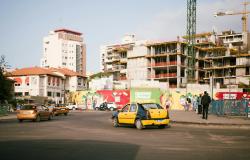
Photo by Amaury Michaux