The Most Dangerous Area in the World

In this column, Alfredo Toro Hardy explains why the so-called First Island Chain of East Asia represents the most dangerous area in the world.
China’s naval strategy is focused on what planners call the “two island chains” of the West Pacific. These are the areas that Mao Zedong envisioned would someday be stripped of American power. The first of those island chains is mainly composed of the Kuril Islands, the Japanese Archipelago, the Ryukyu Islands, Taiwan, the northern Philippines, and Borneo. Contained within this chain we find the South China Sea, the East China Sea and the Yellow Sea.
For China, the control of this area, which it calls the “Near Seas”, is the absolute priority. However, China also aspires to be able to keep the U.S Navy out of the Second Island Chain. This is located within the middle Eastern portion of the Pacific Ocean, and it is formed by the Ogaswara Island, the Volcano Island of Japan and the Mariana Islands (Ward, 2019).
Three phases
Admiral Liu Huaquing, often called the “father of the modern Chinese Navy” and “China’s Mahan” (in reference to America’s main naval strategist, Admiral Alfred T. Mahn), envisaged in the 1980s China’s ‘’offshore defense” naval strategy. This strategy, which remains the fundamental guideline of the People’s Liberation Army Navy (PLAN), had three phases. Phase 1 was to be achieved by the year 2000 and implied the control of the First Island Chain by the PLAN. Phase 2 was to be attained by 2020, when China would have control of the Second Island Chain. Phase 3 was to be reached by 2050, by which time the PLAN would have evolved into a true global navy (Hartnett, 2014).
Obviously, the time frame of the above phases proved to be totally erroneous. In 2025, phase 1 is yet to be fully achieved. Moreover, phase 2 may be unachievable short of a successful military confrontation with the United States, as the Mariana Islands within the Second Island Chain are a U.S. territory. One that includes Guam, which houses America’s strategic naval base.
China’s preponderance
As said, however, controlling the sea area surrounded by the First Island Chain is Beijing’s priority. Indeed, according to Brookings: “The first island chain represents China’s ‘core interest’, specially from the perspective of the PLA combat planning” (Yeo and O’Hanlon, 2023). Its importance for China has two intertwined foundations: National security and enormous economic value. Among the latter, over 60% of the country’s total trade transits through this area, while 75% of its oil and 40% of its gas comes from overseas. On top, the China Seas contain some of the world’s richest fishing grounds and significant oil and natural gas reserves. Although full control of this area has not yet been attained, China is clearly preponderant within it.
The bulk of the PLAN, the largest navy in the world, is concentrated there. Meanwhile, the U.S. naval forces, already smaller in size to that of China, are dispersed across nine regional commands distributed around the globe. This is compounded by the Chinese weaponry in place. Meaning in the Chinese coasts, in its twenty-seven artificial islands in the Paracel and Spratly archipelagos within the South China Sea, and in its vessels. Among these weapons are the DF21/CSS-5 missiles, capable of sinking aircraft carriers at a range of over 1,500 miles (Auslin, 2020).
In other words, China enjoys the “biggest navy by number, biggest coast guard, largest rocket force in the world”. Mainly concentrated within the First Island Chain. On top:
“The scale and pace of shipbuilding gives China not just the ability to put a large fleet at sea and more modernize equipment, but also the ability to maintain and potentially replace losses in war, which is a big difference between China and almost everyone else” (Rosenberg, 2025).
A critic hurdle
Having said that, China confronts a critic hurdle: The chokepoints in and out of the maritime area surrounded by the First Island Chain. That is, the South China Sea, the East China Sea, and the Yellow Sea. And there’s where China’s antagonists can play hardball against it in a potential conflict. In James R. Holmes’ words: “Each annual Pentagon report on Chinese military power…includes a map that traces the island chain…Sealed off by the occupants of the islands, the chain would present a formidable barrier to exit from or entry into the China Seas. This is an ideal opportunity for mischief-making at the PLA navy’s expense. Contingents scattered on and around the islands and straits comprising the first island chain could give Beijing a bad day should things turn grim over the Senkaku Islands, Taiwan, or some other political controversy” (Holmes, 2014).
Taiwan
That is where Taiwan comes into play as a key geostrategic piece both for China and for the U.S., Japan and its regional allies. From a geostrategic point of view, the island’s localization within the First Island Chain can act as a barrier into the South China Sea, the East China Sea, and the Yellow Sea, or as a bottleneck hampering exit from them into the Pacific Ocean. Under Beijing’s control, Taiwan could obstruct the movements of U.S. and its allies in and out of that area. Under Washington’s “de facto” control, Taiwan can become instrumental in bottlenecking China. Moreover, Taiwan as an American ally is a spear that points into mainland China. Not surprisingly, in 1950 General Douglas McCarthur described Taiwan as an “unsinkable aircraft carrier” (Wong, 2025). Conversely under Beijing’s control that spear point towards the Western Pacific, a vital area for the United States.
Japan
Should Taiwan fall under Beijing’s control, this would pose a highly unpleasant scenario for Tokyo. First, under a First Island Chain dominated by China, Japan would face severely constrained chokepoints for entering and exiting the Pacific. Second, the PLAN could break out into the Western Pacific, locating part of its forces on Japan’s Eastern flank, historically a secure direction for this country. Third, Japan would lose its strategic buffer zone in relation to China. Fourth, Japan’s sea lines of communication, vital for its economy and in particular for its energy imports, would become more vulnerable to Chinese pressure. Fifth, as U.S. deterrence credibility would be weakened, the burden on Japan’s military forces would substantially increase. Sixth, China would be able to present itself as the unchallenged regional hegemon, thus reducing Japan’s influence and political weight. Seventh, holding the Senkaku Islands would become substantially harder for Japan.
Not surprisingly, Japan’s Prime Minister Sanae Takaichi recently told lawmakers in Tokyo that a Chinese attack or blockade against Taiwan would represent a threat to Japan’s “survival”, a term that under Japanese law allows the country to deploy its military overseas.
The most dangerous area
As Henry Kissinger once wrote, absolute security for one side inevitably implies absolute insecurity for the other. And, as the tensions within the First Island Chain increase and the zero-sum mentality between China and the U.S. and its allies hardens, each side aims for absolute security. If Taiwan’s reunification with the mainland -a key element within China’s “dream of national rejuvenation”- is added into the equation, things get immensely more complicated. Not surprisingly, the First Island Chain has become the most dangerous area in the world.
Alfredo Toro Hardy, PhD, is a retired Venezuelan career diplomat, scholar and author. Former Ambassador to the U.S., U.K., Spain, Brazil, Ireland, Chile and Singapore. Author or co-author of thirty-six books on international affairs. Former Fulbright Scholar and Visiting Professor at Princeton and Brasilia universities. He is an Honorary Fellow of the Geneva School of Diplomacy and International Relations and a member of the Review Panel of the Rockefeller Foundation Bellagio Center.
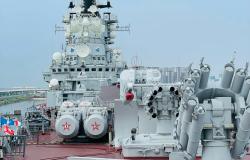
Photo by Shuaizhi Tian
References
Hartnet, Daniel (2014). “The Father of the Moden Chinese Navy Liu Huaqing”, Center for International Maritime Security, October 8.
Holmes, James, R. (2014). “Defend the First Island Chain”, U.S. Naval Institute, April.
Rosenberg, Barry (2025). “As China pushes out from the First Island Chain, US allies like Japan and the Philippines survey from nearby”, Breaking Defense, November 17.
Ward, D.T., Jonathan (2019). China’s Vision of Victory. Washington D.C.: The Atlas Publishing and Media Company.
Wong, Enoch (2025). “What is the US’ island chain strategy and what does it mean for China”, South China Morning Post, 16 June.
Yeo, Andrew and O’Hanlon, Michael E. (2023). “Geostrategic Competition and Overseas Basing in East Asia and the First Island Chain”, Brookings Policy Brief, February.