Book Review - Contender States and Modern Chinese International Thought: From the Republican Era until the ‘Chinese School of International Relations’

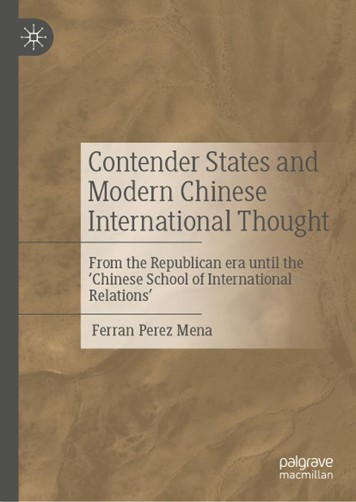
Contender States and Modern Chinese International Thought: From the Republican Era until the ‘Chinese School of International Relations’ by Ferran Perez Mena. Palgrave Macmillan 2024. 216 pp., £109.99 hardcover 978-981-97-2150-4, £87.50 e-book 978-981-97-2151-1
There has been persistent interest in the field of non-western international thought, although it is uncommon to see discussion of such ideas as a world-historical phenomenon (Acharya and Buzan 2009; Chen 2010; Cooke 2022; Shilliam 2010; Tickner, Blaney, and Waver 2012). It is widely noted that non-western theories have been overwhelmed by western hegemony despite the continuous accumulation of power away from the West (Acharya and Buzan 2007). Colonial cultural structures have compelled local elites to assimilate rules and norms of hegemonic knowledge production, spontaneously reproducing a ‘whole set of key Western ideas about the practice of political economy’ with even greater emphasis on universal categories like sovereignty and nationalism (Acharya and Buzan 2007, 294). Nevertheless, possibilities for non-western theories have never been ruled out and although the West has a big head start, ‘what we are seeing is a period of catching up’ (Acharya and Buzan 2007, 299). Ferran Perez Mena’s book Contender States and Modern Chinese International Thought is a project designated to understand such ‘catching up’ processes in the context of IR theories in China.
 Perez Mena’s book is built upon an impressively vast coverage of IR theories and broader international thought in China, which are considered results of the complex relationships with the West. Perez Mena deploys two primary frameworks to interpret Chinese international thought: Kees van der Pijl’s ‘Contender States’ and Justin Rosenberg’s ‘Uneven and Combined Development’ (U&CD), each of which possesses lexicons that purportedly pin down the catching up phenomenon in world history (Perez Mena 2024, 48–52). Perez Mena argues that the production of IR in China is generally a reflection of China’s unique international circumstances, and the latter has constituted a theoretical explanation of the former. Drawing on U&CD (Rosenberg 2013), Perez Mena argues that geopolitical experiences as a backward state has foregrounded China’s knowledge production of IR, and that ‘the evolution of modern Chinese international thought has been shaped by various ‘historical constellations’… characterized by significant processes of economic catch-up, state formation, and geopolitical competition involving China and other advanced states’ (Perez Mena 2024, 47). Evolutionary ‘historical constellations’ as a result of ‘the international’ have culminated in China’s identity as a contender state (van der Pijl 2006, 2012), which has not only centralised the role of the state/ruling party as the organiser of social development and political accumulation, but also defined the state as having ‘ontological primacy’ in formulating realist-oriented international thoughts that has in turn perpetuated China’s self-positioning as a contender state in world history (Perez Mena 2024, 50).
Along the line of the above internationally informed formulation, Perez Mena has provided a historiography of China’s international thought in three stages. He traces the origins of China’s modern international thought to the Republican Era (1912-1949) and Mao’s period (1949-1976) when China experienced destructive political turmoil and humiliating geopolitical exigencies. It is noted in the book that China’s international thought assimilated a great deal of ‘privileges of backwardness’ for industrialisation and modernisation (Trotsky 2008, 4), through connections with advanced states such as Japan and the Soviet Union/Comintern (Perez Mena 2024, 61; Vogel 2019, 134). Perez Mena indicates that the centrality of statism in knowledge production took root in the Republican Era, and curiously, he makes Yuan Shikai, the self-crowned emperor together with other prominent figures such as Sun Yat-sen and Li Dazhao, a case study of iconic thinkers and contender state-builders. This is a provocative view especially by recasting Yuan’s vision as ‘to ensure the security of the state apparatus and create a favourable international environment’ (Perez Mena 2024, 68). Such an appraisal of Yuan aligns with contemporary revisionist views that see him as a reformer, while contrasting with the Marxist-Leninist views in China that dismisses him as an opportunist who aborted revolutionism and the contender state (DiMarco 2017; Shan 2018; Yong 2012).
The second stage of China’s international thought formulation is identified as the development during the Reform Era since 1978. Perez Mena compellingly describes this stage as a move to embrace the disciplinary identity of IR and the exploration of western social sciences in the relaxed political and social atmosphere of Reform. Assimilating a supposedly ‘western discipline’ is contested enough in China, and circumstantial generalisation is common as early Chinese scholars have conflated IR theories to an ‘American School’ with little awareness of Stanley Hoffman’s reflection on IR as an American discipline (Liang 1997; Song 2001). These scholars were trained in the old system dominated by revolutionary discourses, while they also sensed the allure and excitement of western intellectual influx in the early days of Reform. Perez Mena has posited the scene as both ‘concerted efforts to marginalize Marxism-Leninism and Mao Zedong’s thought’ and continuous articulation of the contender-state position (Perez Mena 2024, 117). A very adroit observation made in this part is that China’s ‘Pilgrimage to the West’ since 1978 took place in the context of a contender state while there was a joint compulsion from both the state and the society to make up for the loss of the Cultural Revolution (Wang 2009). This vision leads to Perez Mena’s reinterpretation of China’s internalisation of realism amid the paradigm shift away from revolutionary doctrines, through which realism has arrived in China as a source of ideas for defending the state amid widespread liberal ideas. Reading of the key figures such as Yan Xuetong and Shi Yinhong along this line is historically sensible (Perez Mena 2024, 123–24).
Regardless of the rather contradictory time when IR scholars were both keen to engage western ideas and defend the statist position from the 1980s, the recent time in the intellectual development of China’s IR is characterised by both the context of ‘peaceful rise’ and the revival of Sinic values. Perez Mena has investigated the popular discourse of ‘the Chinese School of IR’ and reviewed a few representatives of the wave. It is well noted that such a school has actively incorporated concepts from China’s traditional thought including guanxi (relationality), harmony and gongsheng (symbiosis). Given the vastness and ambiguities of Chinese classics, it is hard to visualise strategies under which traditional ideas are chosen, and calls to return to the classics could be selective and instrumental (Zhang 2023). Perez Mena is apparently less concerned with this problem while he focuses more on projecting China’s global status as a backdrop for those intellectual developments. Yan Xuetong’s moral realism is read more as a replacement of revolutionary-Marxist ideas with ‘Chinese wisdom' to envision China’s emerging global leadership (Perez Mena 2024, 162).
Perez Mena’s book is original as it has provided an alternative historiography of China’s international thought as an emergent property of the backward geopolitics pertaining to the project of contender state. As the above outline has shown, such a framework has elicited insightful reinterpretations of both political practitioners and academics. It can be seen in the above three stages of intellectual development responses to both geopolitical crises and contender state-building as ‘ontological primacy’. However, the framework in the book may risk over-generalisation and omit many nuanced (sub)contexts beyond the ‘catching up’ process. An obvious problem is that thinkers assume different roles in a society where they could be imperial militarist, revolutionary or professional academic. Putting Yuan Shikai and Shi Yinhong in the same bracket of contender state thinkers could be a misleading conflation.
Moreover, as complex social, institutional, and even interpersonal contexts and sub-contexts differ, purposes of knowledge production may also vary, raising questions about whether producers are pursuing genuine internationally informed wisdom or only serving local-national agendas (Wæver 1998, 688–89). Perez Mena will certainly agree with Justin Rosenberg’s distinction between bureaucratic and emancipatory modes of knowledge, with the former fixated in a power structure that secures one’s status, and the latter using IR as a vehicle to question existing orders (Rosenberg 1994). He will therefore realise the weaknesses in his narratives about the post-1978 ‘international thinkers’ who mainly work in China’s IR institutions and ‘national key universities’. It is obvious that these professionals will from time to time need to engage with the administration’s policy initiatives which do not necessarily square with the meaning of a contender state. For example, the ongoing restoration of Sinic values is largely an officially commissioned project for the so-called ‘independent knowledge system’, which is not really ‘internationally minded’. Beyond academic fundraisers and bureaucratised nationalists, there must still be genuinely ‘internationally imaginative’ figures who might have more actively incorporated ideas such as U&CD and the contender state; but it is important to first identify them in China’s complex intellectual ecosystem.
Dr. Xin Liu is Senior Lecturer in International Relations and Asian Studies at Liverpool John Moores University.
References
Acharya, Amitav, and Barry Buzan. 2007. ‘Why Is There No Non-Western International Relations Theory? An Introduction’. International Relations of the Asia-Pacific 7(3): 287–312.
Acharya, Amitav, and Barry Buzan. 2009. Non-Western International Relations Theory. Taylor & Francis.
Chen, Kuan-Hsing. 2010. Asia as Method: Toward Deimperialization. Duke University Press.
Cooke, Samantha. 2022. Non-Western Global Theories of International Relations. Springer.
DiMarco, Francesco. 2017. ‘Reframing Yuan Shikai: The Institutional, Rhetorical, and Religious Foundations of the Monarchical Attempt, 1915-1916’. The Ohio State University.
Liang, Shoude. 1997. ‘Constructing an International Relations Theory with “Chinese Characteristics”’. Political Science 49(1): 23–39.
Perez Mena, Ferran. 2024. Contender States and Modern Chinese International Thought. Springer.
van der Pijl, Kees. 2006. Global Rivalries from the Cold War to Iraq. Pluto Books.
van der Pijl, Kees. 2012. ‘Is the East Still Red? The Contender State and Class Struggles in China’. Globalizations 9(4): 503–16.
Rosenberg, Justin. 1994. ‘The International Imagination: IR Theory and’Classic Social Analysis’’. Millennium 23(1): 85–108.
Rosenberg, Justin. 2013. ‘Kenneth Waltz and Leon Trotsky: Anarchy in the Mirror of Uneven and Combined Development’. International Politics 50(2): 183–230.
Shan, Patrick Fuliang. 2018. Yuan Shikai: A Reappraisal. UBC Press.
Shilliam, Robbie. 2010. International Relations & Non-Western Thought. Routledge London.
Song, Xinning. 2001. ‘Building International Relations Theory with Chinese Characteristics’. Journal of Contemporary China 10(26): 61–74.
Tickner, Arlene B., David L. Blaney, and Ole Waver. 2012. Thinking International Relations Differently. Routledge London.
Trotsky, Leon. 2008. History of the Russian Revolution. Haymarket Books.
Vogel, Ezra F. 2019. China and Japan: Facing History. Belknap Press.
Wæver, Ole. 1998. ‘The Sociology of a Not So International Discipline: American and European Developments in International Relations’. International Organization 52(4): 687–727.
Wang, Hui. 2009. The end of the revolution : China and the limits of modernity The End of the Revolution : China and the Limits of Modernity. London ; Verso.
Yong, Ma. 2012. ‘From Constitutional Monarchy to Republic: The Trajectory of Yuan Shikai’. Journal of Modern Chinese History 6(1): 15–32.
Zhang, Feng. 2023. ‘The Conception of Morality in Moral Realism’. In The Essence of Interstate Leadership: Debating Moral Realism, eds Xuetong Yan and Yuanyuan Fang. Bristol University Press, 93–112.