The US-Israeli War on Iran Risks Setting Socio-Economic Development in the Middle East Back Decades

Mark Furness argues that the violence resulting from the war’s three main players’ pursuit of incompatible political objectives is likely to cause lasting damage to socio-economic development in the Middle East.
In recent decades, civil and international wars, foreign interventions, repressive rentier-authoritarian political economies and deepening environmental crises have hindered socio-economic development in the Middle East. Living standards have stagnated amid a region-wide authoritarian consolidation in the decade and a half since the dashed hope of the Arab Uprisings.
Nevertheless, according to a recent progress report, the region has made uneven progress towards achieving some of the Sustainable Development Goals, especially in education, healthcare and access to water and sanitation. The destabilisation created by the US-Israeli war on Iran risks setting even this modest progress back decades.
Despite the unprecedented level of US-Israel military cooperation, their diverging political interests with regard to Iran are likely to create lasting chaos in the region.
The contradicting justifications for the war offered by senior US policymakers have somewhat obfuscated American motivations for attacking Iran. It is nevertheless clear that the threat posed by Iran’s nuclear weapons programme to the US and the region is baseless. Oman’s Foreign Minister Albusaidi stated that the Iranian regime had agreed never to pursue a nuclear weapon in talks with the US held in Geneva the week prior to the attacks. Similarly, President Trump’s claim that the US was acting to free the Iranian people from the oppressive clerical regime is hardly credible given the US lack of support to the protests that were brutally suppressed by the Iranian regime in January.
The United States’ reasons for attacking Iran are more likely related to the threat that Iran poses to its geo-economic and geo-strategic interests. In recent years, the Iranian regime has actively tried to avoid sanctions by selling oil outside the petrodollar system, for example selling oil to China in Yuan. Just as was the case with Venezuela, the USA has attempted to replace a rival regime with a compliant one, and at the same time squeeze China’s access to resources.
However, aside from the likelihood that cutting off Iranian oil will likely increase mutual dependence between China and Russia, this strategy relies on finding a partner in Iran to deal with. The Israelis have reportedly assassinated not only Iran’s supreme leader Ayatollah Ali Khamenei, but also several other senior figures who might have been able to fulfil this role. The Iranian Supreme Council’s decision to appoint Khamenei’s son Mojtaba as the new supreme leader is a major blow to American interests. Given that the new Iranian leader’s wife and son were also killed in the attack on Khamenei’s compound, it is highly unlikely that he will be willing to do deals with Trump.
Israel wants to re-set the military and political balance of power and remove its last serious strategic rival in the Levant. Iranian support for powerful proxies in Syria, Lebanon and Gaza has until recently prevented Israel from attacking Iran, while previous American administrations have been unwilling to give Israel free reign due to the risk of escalation. Following the 7 October 2023 terrorist attacks on Israel and the 2024 re-election of President Trump, Israeli Prime Minister Netanyahu has both the opportunity and the American support to make a move he has wanted for most of his political career. Since 2023, Israel has destroyed Hamas and Hezbollah, and the Assad regime has fallen. Iran’s capacity to retaliate has been heavily diminished.
Israel’s scorched earth strategy is incoherent with American interests in regional stability and in securing access to Iranian oil. The far-right coalition government that Netanyahu leads wants to ensure that Israel’s neighbours do not have capabilities to resist Israel’s appropriation of Palestinian territory. The Israelis consider that they can control the region by force, but continued upheaval is likely to foster an environment where terrorism can flourish, targeting American assets and allies in the Middle East, Europe and beyond. A nightmare scenario where Iran descends into civil war would risk a regional conflagration drawing in the Kurdish regions, Azerbeijan, Turkey, Iraq and the Gulf States, with inevitable impacts on national and regional economies, no matter who is in nominal control of Iranian oil infrastructure.
The Iranian regime’s strategy in response to the US-Israeli attacks is simple: raise the costs and survive the crisis. The oil-shock driven inflation caused by Iran’s closure of the Straits of Hormuz will have a political impact in the USA, fuelling anger at Trump’s decision to break his election promises and put American military personnel at risk in the Middle East. Iranian drone and missile attacks on its Gulf neighbours are also intended to encourage them to pressure the US and Israel to cease hostilities. Trump’s weak resolve and preparedness to abruptly change course and blame others for failures is well known, and the Iranian regime is clearly counting on outlasting the American President.
The development impacts of the violence are being felt across the region. The illusion of stability in the Gulf has been shattered. The United Arab Emirates relies on stability as a global connectivity hub and has around 90% foreign-born population. Many want to leave, taking their investments and expertise with them. Iran has deliberately targeted foreign investment, attacking American technology companies and data centres. Physical and digital logistics networks are under pressure and the ambitious India-Middle East Corridor connectivity initiative is on hold. The impact on significant development processes like reconstruction in Syria and Lebanon is likely to be high as foreign investors and development donors re-evaluate their priorities. International tourism is expected to be hit particularly hard.
There are also likely to be lasting development impacts on Iran itself. Assuming the Iranian regime survives, the country will continue to be subjected to international sanctions, the socio-economic effects of which affect the general population much more than its leaders. If the Iranian regime collapses, sparking a regional war, the potential socio-economic damage is incalculable. The resulting displacement would further burden neighbouring countries already struggling to absorb refugees from previous conflicts.
The environmental impact is already apparent from Israeli attacks on oil infrastructure in and around Teheran, with risk of a major catastrophe if an oil tanker is sunk in the Straits of Hormuz. Attacks on military bases and energy infrastructure have also damaged desalination plants that provide fresh water, risking a humanitarian catastrophe and raising the spectre of water being used as a weapon across the region.
The sobering reality of the Iran war is a reminder that nobody wins when powerful countries violate the UN Charter’s prohibition of international aggression. Even if the war ends quickly, the socio-economic damage to the Middle East will be lasting.
Dr. Mark Furness, Senior Researcher, German Institute of Development and Sustainability (IDOS), Research Department ‘Inter- and Transnational Cooperation’.
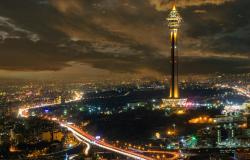
Photo by Hamid Reza Darajati