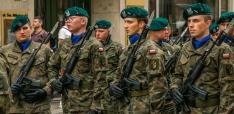
Poland’s Paradox: From the Polish Plumber to Polish Power

As the world spirals into ever more uncertainty, Marek M. Jaros and Robert Schuett show how Poland’s strategic situation captures the wider resurgence of geopolitical competition and anxiety across Europe.
Poland is widely recognized as one of Europe’s economic darlings. Its rise from post-communist recovery to a position of genuine economic power is well known. Simultaneously, Poland occupies a far more precarious position as a frontline state on Europe’s eastern flank, where it borders a Russia that has returned to open revisionism. That revisionism, although concentrated on the post-Soviet world, are felt in Poland as well. Recently, Prime Minister Donald Tusk stated that Poland is preparing to deploy drone-based protective systems to secure key infrastructure following an explosion on a rail line that he claimed was the result of Russian sabotage.
This combination of economic strength and acute strategic exposure places Poland at the center of Europe’s unfolding security crisis. Despite this, the Polish position often receives far less analytical and political attention than it deserves, which risks obscuring both the scale of the challenge and the significance of how Poland is responding to it.
Geopolitical conflict behaves tectonically. Conflict between great powers brings about new state systems, such as in 1815 Vienna, 1919 Versailles, and 1945 Potsdam. The present system is a product of the latter. Few can contend that our world resembles the one of Potsdam. The USSR disintegrated. The UK is a shadow of its imperial self. Europe has united, at least de jure. China is ascending economically and militarily. The center of the global economy races eastward. A new state system will soon be established, whether by means peaceful or bloody. Revisionist powers will have a chance to shape the state system.
As geopolitical power departs the European continent, it remains a place of conflict. European nations, startled into action by Russia’s war of aggression against Ukraine are feverishly investing in defense for the first time in a generation. They find themselves in a political paradox of insecurity, fear, instability, and inability. Every European nation shares in some, or all, of the issues Poland must confront, but the Polish case is most dire.
Poland is not a novel place of conflict. Famously, and tragically, it has been the victim of four partitions at the hands of ambitious, often murderous, powers stronger than itself. It was most recently threatened by a fifth partition in the 1990s. Poland has one of the most unfavorable geopolitical position imaginable. Russia is an ancient and perpetually vengeful enemy to the east. Germany, although nominally allied with Poland, has the highest polling party in the Bundestag openly stating that Russia should again be a German ally and that Poland poses a threat. Even the most reactionary comparison to the Molotov-Ribbentrop pact can be somewhat excused given the history of the region, the polling, and the electoral trends of the AfD. Add to this a lack of geographic obstacles and the complicating factors of demographic decline and energy insecurity, and what emerges is the nightmare of any rational foreign and security policy strategist or military planner.
Poland has attempted to alleviate its geographic and demographic disadvantages via a tri-partite security policy. First, the nascent free Poland worked to join NATO and the European Union, both accomplished in the late nineties and early two-thousands. This provided the ability to call on both organizations’ collective security covenants. Second, Poland pursued a policy of reconciliation with its historically estranged neighbors – Ukraine, Lithuania, Slovakia, and Czechia, establishing both bilaterial and multilateral relations – via the Visegrad Group - to improve ties with its neighbors, establishing a ring of allies. Third, Poland pursued a close relationship with the United States. It hosts US troops and bases on its territory, and has recently requested the US station nuclear warheads on its soil. Even during the isolationist Trump administration, Poland has offered to rename bases in honor of the 45th/47th American President in exchange for US troops being stationed on its territory. In fact, Poland went so far as assisting the United States in it’s Afghanistan intervention.
Together, these three layers of security were meant to prevent a situation such as in 1939, where the only security guarantee failed with no available alternative.
Despite its redundant design, the Polish security architecture has effectively collapsed since 2022. Each layer has become either ineffective or questionable, if not both. The European Union, dogged by its endemic bureaucracy and sluggish progress has been slow to translate words, directives, and invectives into any tangible security assets nor serious geopolitical coordination among its members. NATO, although it has a more significant security infrastructure and political architecture suffers from latent American disinterest and the spoiling effect of nominally pro-Russian governments in Slovakia under Fico and Hungary under Orban. That is to say, it is doubtful as to whether they would permit Article V to be invoked if necessary.
The Visegrad Group is plagued by pro-Russian populists. Poland is the only nation of the group not currently governed by a populist, (and in some form) pro-Russian government. It’s other neighbors, the Baltic states, are preoccupied dealing with their own Russian incursions with their even more limited resources, making it doubtful they would be able to come to Poland’s aid should the necessity arise, and that is before the Suwałki gap is even discussed.
In essence, the three pillars of Poland’s security structure (Nato, neighbors, and the United States) are under immense strain, and Poland is pursuing alternatives.
Much like other nations, Poland has pursued a policy of autonomy in many defense matters, re-shoring defense production capacity and defense capabilities. Poland has invested heavily in all aspects of its military, already exceeding the new NATO spending targets target in the current budgetary period. However, the adoption of a semi-autarchic defense posture implicitly admits that the previous collective security strategy has effectively failed. Otherwise, pooled resources would suffice.
Moreover, such an investment in material and manpower severely constrains a state budget already saddled with an aging population and a strong social safety net. Poland’s economy has had a period of growth, but no economic expansion can be indefinite. It is an open question whether these spending commitments can be upheld, politically, fiscally, and economically, should a downturn occur. In short, the policy is not sustainable nor a solution to the geopolitical problems faced.
Poland is only one of the nations facing down the realities of a resurgent history that refuses to end. All of Europe faces aspects of the Polish situation with the same constraints. As George Friedman noted in his 2015 book, Flashpoints: The Emerging Crisis in Europe: For European in particular, nothing of significance is ever over, and Europeans may choose to fight. And why wouldn’t they? History, the state, sovereignty, geography, and survival provide powerful incentives to go to war.
Add to that the omnipresent sentiment – not only in Poland – that the Eurasian security dilemma cannot be solved, nor managed within the long-term European project, nor within the preexisting security architecture of the continent. It is quite clear that difficult decisions must be made to create new security architecture that will address current needs in the present context. Those choices will require a heavy dose of political realism, while carefully balancing material interests with political ideas of post-communist freedom and progress.
Marek M. Jaros is currently a Masters student at the Diplomatic Academy in Vienna and an alumnus of Michigan State University’s James Madison College. His research focus is on Eurasian geopolitics, with a particular expertise on Poland’s strategic position and its domestic politics.
Dr. Robert Schuett is co-founder and managing partner at STK Powerhouse, a global risk advisory firm. A former Defense civil servant, he also serves as Chairman of the Austrian Political Science Association and is a long-standing Honorary Fellow at Durham University.
Photo by Jade