Poland and the Sword’s Edge

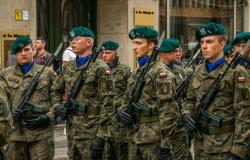
The security dilemma is as old as politics itself. Marek M. Jaros and Robert Schuett argue that Europe ignores it at its peril.
As the world descends into the confusing fog of an interregnum, the banalities of yesterday become the unknown variables of today. There are few more lauded achievements of the departing state system than peace on the European continent.
Yet, as the continent engages in a feverish race to rearm, that achievement falls into question. Within rearmament lie the possible seeds of that achievement’s destruction. The threat is real and analyzed through the Polish lens it seems that there are three paths forward – the European, the autarchic, and the present.
The European pax neoliberalis was buttressed by NATO and the United States. The US was the de facto benevolent hegemon of the continent, preventing conflict and protecting the old world within the auspices and coordination of NATO. This certainty seems no longer true. The Trump Administration no longer appears to want this form of hegemony over Europe—at least not in the present form. NATO, because of its US-centric structure, is also called into question. Hence, Europe has, wisely, chosen to end the pacifistic policies of the preceding three decades and has begun to rebuild its militaries.
However, Europe does so without the benefit of an effective security architecture, and any form of rearmament introduces the security dilemma back to the continent. First described by John H. Herz, the dilemma refers to a prisoner’s dilemma-esque situation whereby ostensibly defensive armament by one actor begets armament by other actors in order to maintain what they perceive to be a balance of power against the initial actor. Whether or not Europe recognizes it at present, the dilemma is likely destined to come into play within Europe. The recent trend of domestic revisionism amongst populist governments across Europe, including the Polish KKP, may herald the return of international revisionism to the halls of European power. Yet, even if revisionists do not achieve power in the respective European parliaments, the very specter of their ascendancy may prove sufficient fodder for insecurity.
In the Polish case, the trappings of insecurity are already apparent. Recently, President Karol Nawrocki (PiS) has called for the construction of defensive positions on the Polish-German border in addition to measures that counter Russian aggression. He is not alone in these calls. Similar messaging has come from the Polish far-right, from former presidential hopeful Słowomir Mentzen, who commemorated the beginning of the Warsaw uprising with a Berlin rally under the slogan “we won’t let you forget what you did.” Similar cultivation of historic grievances will almost certainly prove fertile ground for other European populists to use the prospect of conflict to pave their own way to power.
The dissenters of the security dilemma’s re-birth on the continent point to political and economic integration as preventative measures against conflict. However, in the realm of international security there is no magic bullet. Both arguments suffer from a common and basic misunderstanding of politics — the assumption of rationality in decision making. Politics is not inherently rational — it is, for the most part, emotional. Unfortunately, both “magic bullets” are based on rational consideration of available options. In the economic sense, it assumes nations choose the more economically advantageous options of free trade, which is an assertion empirically debunked by Brexit. In the political sense, it assumes states seek to preserve and protect their relationships with other states. This argument, aside from ignoring the pathos of politics, has the misfortune of being a product of historical illiteracy. One needs only look at the state of integration in 1914 and 1792 to find fissures in the argument. There is no magic solution to the vicissitudes of international politics — and no way to easily curb either the perceived or the emotional self-interest of a populus.
Europe has a choice to make with regard to rearmament: The Polish model or the European model. Poland, due in part to its head start in rearmament and to its soft Euroscepticism, has developed a degree of defense autarchy previously discussed. While it does cooperate within existing security arrangements, the primary focus of Polish rearmament appears to be a significant degree of security autarchy. An autarchic Europe would face two problems: one is practical, the other being theoretical. From the practical side, a lack of strong coordination of armed forces could lead to the historically replete trend of coalition infighting and limit the efficacy of any joint force. From the theoretical perspective, leaders may be reluctant to spill blood over what is perceived as a distant problem.
The European solution, involving significant military and political integration, suffers from two practical issues. Military integration in Europe would likely take place through the European Union. It already has established legal avenues for this — namely PESCO CSFP procedures. However, the prospect of further European integration is a politically questionable one the continent over—putting aside the nations who are prohibited from entering into military alliances. Moreover, PESCO cooperation is voluntary and can easily be revoked or otherwise altered at the slightest vicissitude of domestic politics or convenience. The deeper problem here is that defense of the realm is the foundational responsibility of the state—from Hobbes to Rousseau to Locke to the ancients; all describe defense as the first and most basic responsibility of any state. Subjecting that core responsibility to such a voluntary model of collective security may prove to be a dangerous long-term proposition. This is also putting aside the more familiar problem of free riders, who may be coaxed into PESCO programs but not into applying them to neither intended nor effective extents.
Neither of these solutions is particularly preferable. Both suffer from serious drawbacks. However, one has to be chosen. They will not be easy to implement, neither practically nor politically. Nevertheless, one has to be chosen. Not making a choice is a decision in and of itself. It will prove to be the most destabilizing of the three possibilities, having all the inefficiencies of the Polish model and the drawbacks of the European model. The best way to rationalize the collapse of continental security stances in the wake of the American pullback from Europe and to conduct an efficient rearmament is simple albeit not easy – to choose.
In previous articles, we have reviewed the security situation on the continent, and the problems of rearmament at the domestic level. In responding to the former and implementing the latter, Europe seems to have forgotten that war is not impossible on the continent. It is not improbable, either.
Rearmament has within it the fuel for an endless list of situations where the continent spirals toward conflict. The magic bullets of political and economic integration are not entirely effective — nothing is. Rather than denying the risk inherent in rearmament, political parties and governments across the continent will need to make a concerted effort to protect the strategic progress of the past. If Europe truly is, or aspires to be, the geopolitical player of Commission President Ursula von der Leyen’s rhetoric, it needs to start acting akin to a realistic actor that understands the evolving intricacies of European and transatlantic dynamics—past, present, and future—and act upon them with a heavy dose of political realism. Ideals, words, and statements will not carry the moment—action might.
Marek M. Jaros is currently a Masters student at the Diplomatic Academy in Vienna and an alumnus of Michigan State University’s James Madison College. His research focus is on Eurasian geopolitics, with a particular expertise on Poland’s strategic position and its domestic politics.
Dr. Robert Schuett is co-founder and managing partner at STK Powerhouse, a global risk advisory firm. A former Defense civil servant, he also serves as Chairman of the Austrian Political Science Association and is a long-standing Honorary Fellow at Durham University.
Photo by SHOX art